Before You DCA, Get the Account Right: Binance Signup, Verification and Security
Open the account before your first DCA buy: BN1918 and the sign-up link
Your first DCA contribution can only land if there is an account that charges you on schedule. In order: what to have ready before you register, how to fill in the signup form, what identity verification asks for, what to check after a rejection, and the security settings to do the same day the account is opened. That last part matters most for DCA, because the account is left running long-term and you may not log in for months.
- Why DCA needs an exchange account
- What you need to open a Binance account: email, ID, authenticator
- The signup flow, and where the referral code goes
- Identity verification: photographing your ID, and what to check after a rejection
- The security settings that belong on day one
- Account ready: first deposit, then the DCA plan
- Can DCA lose money? What to accept before you open the account
Opening a Binance account comes in three stages: signup, identity verification and security settings. Binance's Help Center says verification documents are usually reviewed within 48 hours. Nobody chases you over the security settings, yet for a DCA account you log in to once every few months they matter most.
Why DCA needs an exchange account
Every benefit of DCA rests on one thing: the buy happens on the date, not when you decide the price looks right. For the buying to happen automatically, something has to execute it for you, and an exchange is the lowest-barrier place to hand that job to.
Three things make the account a necessity. The automatic charge. An exchange's built-in recurring buy places the order at the frequency and amount you set, which is what turns “don't time the market” from a slogan into the default: you don't open the app each round, so the price gets one less chance per round to sway you. The on-ramp. Your money has to become a balance that can buy crypto, and the exchange provides that route. Holding the coins. What DCA buys has to sit somewhere, and the exchange account is the least-effort choice.
That convenience has a cost that needs stating: coins on an exchange are coins whose private keys you don't hold; what you have is an entry in the platform's ledger. There is precedent for a platform failing its customers: in December 2022 the U.S. Securities and Exchange Commission charged the founder of the trading platform FTX, alleging among other things that FTX customers' funds had been diverted to Alameda Research (see SEC press release 2022-219). My suggestion: keeping everything on the exchange at the start is reasonable, since it is convenient and the barrier is low; once the DCA position has grown to a size you'd hate to lose, consider moving part of the bitcoin to your own wallet and keeping the seed phrase yourself.
What you need to open a Binance account: email, ID, authenticator
It's a short list, but missing one item means stopping halfway to find it, so get everything together first:
- An email address you'll keep using for years. Not your work address, which you lose the day you leave the job, and not an old one you registered in passing and no longer know the password to. This inbox is the root of the account: password resets and security notices all go there.
- Your own valid ID. A passport or the identity document of the place you live; check first that it hasn't expired and that the corners are intact. Which document types are accepted is whatever Binance's verification page lists at the time, and it differs by country and region.
- A phone number that can receive codes. Signup and later security actions both use it.
- The authenticator app already installed. Google Authenticator, Authy or similar. With it on your phone you can use it the moment signup is done.
- Somewhere to keep the password. A password manager ideally; paper in a drawer works too. Don't count on remembering a password that is complex enough.
One thing isn't on that list and matters more: be clear what kind of money this is. If you haven't yet worked out how much to put in per round, or whether losing all of it would affect your life, read How much should I invest in bitcoin? first, then get your ceiling from the position sizer. The account can be opened any time; there's no hurry before that number is settled.
The signup flow, and where the referral code goes
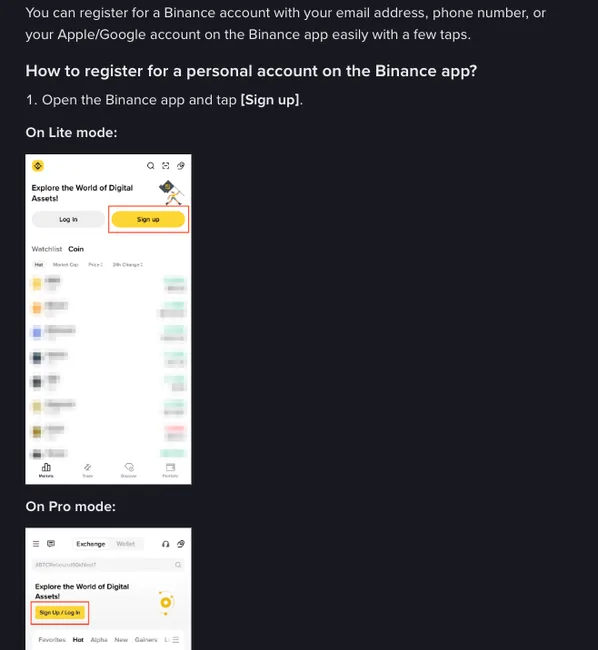
The app and the website change their look from version to version; the order of the steps is this:
The Binance signup link carrying this site's referral code is below. For what the discount covers and which regions it doesn't reach, see step 4 of this signup flow.
Go to Binance sign-up →Disclosure: if you register through this site's link or referral code, the site may receive a referral fee from Binance; your own fees do not go up. Crypto is risky; this is education, not investment advice.
- Open the official signup page. Check the domain yourself, or arrive from a link you trust. A phishing copy can differ from the real site by one or two letters, and a password typed there goes straight to someone else. Get careless at this step and the security settings later can't protect you.
- Pick a sign-up method. Email or phone both work, and Binance also supports signing up with an Apple or Google account or with Telegram. Email is the better choice: once a phone number is cancelled or changed, an account tied to a dead number is a real nuisance.
- Set a password. Use one you use nowhere else, not the one from your email or social accounts. Credential stuffing works by trying passwords leaked elsewhere against your exchange login; reusing one fits two locks with the same key.
- Look at the referral code field. The form has a field labeled referral code or invite code (optional); if it's collapsed, tap it open. This site's referral code is BN1918, which gives up to 20% off trading fees. The discount applies to trading fees on spot and similar fee-based orders; Convert Recurring buys carry no separate fee to discount, so the code saves nothing on the recurring buys themselves. Binance's current terms apply. Binance.com does not accept U.S. residents, and since 1 July 2026 accounts registered in the EEA cannot take part in Binance's referral program, so the code brings them no discount. The field is easiest to fill in at signup: an account that skipped it can bind a code afterward only if it is within 30 days of registration, has no deposit or trading activity and meets the other conditions, which are listed under question 4 of Binance's Referral Pro Mode FAQ.
- Enter the verification code and finish. Type in the code from the email or SMS and the account exists.
- Don't deposit yet; turn on two-factor first. As soon as the account exists, go straight to security settings and work through the items in the security section below. An empty account is the easiest to configure, so don't leave it until there's money inside.
If you haven't settled how much to put in per round, try the amount and frequency in the DCA calculator first, then come back to the signup form; you need both numbers when you set up the recurring buy.
Identity verification: photographing your ID, and what to check after a rejection
There is no way around identity verification (KYC). Binance's Help Center page How to Complete Identity Verification for a Personal Account (updated June 2026) says all new users are required to complete identity verification to access Binance's products and services, including cryptocurrency deposits and trades. Without it, recurring buys can't run either. Which documents to submit is whatever your verification page asks for.
Verification has two stages: uploading the document, then the face check. A rejection means shooting again and waiting again, so it pays to get the photo right the first time.
Photographing the document: find even light and don't shoot directly under a ceiling spotlight, because glare on the surface blurs it. Lay the document flat on a dark surface with all four corners in frame, and don't crop the edges to make it look bigger. Zoom in afterward and check that the document number and your name are clearly legible. Photograph the original, not a photocopy, a scan or a picture of a screen.
The face check: the same page asks you not to wear hats or glasses or use filters, and to make sure the lighting is sufficient. Don't stand with a window behind you, follow the prompts through to the end, and don't switch away to take a call; if the connection is unstable, try again somewhere else.
After a rejection, go through these before you resubmit:
- Is there glare, blur or a missing corner in the photo? That comes down to how it was shot; retake it as described above.
- Did you photograph the original? Replace photocopies, shots of a screen and retouched images.
- Do the details you entered match the document? Spelling of the name, order of given name and surname, date of birth: check them character by character, especially if your name is hyphenated, accented or transliterated.
- Has the document expired? If so, renew it first.
- Is it your own document? Don't register with someone else's ID. If the verified name and the owner of the money don't match, you'll have a hard time explaining it at a withdrawal or a risk review.
The same page says submitted documents are usually reviewed within 48 hours, though some cases take longer; don't resubmit repeatedly while you wait.
The security settings that belong on day one
A DCA account and a short-term trading account carry different kinds of risk. Someone trading logs in daily and spots anything odd that day. With DCA it's the reverse: once the automatic buy is set, the ideal is not to look at all, and a quarter without logging in is normal. So if something does go wrong, months can pass before you find out.
A DCA account's security therefore can't rest on “I'll notice in time”; the doors have to be locked beforehand. Do the following in one go while the account is still empty:
- Second factor in an authenticator app, not just SMS. SMS codes can be intercepted through SIM hijacking, where someone uses forged paperwork to get a carrier to reissue your number. The codes an authenticator app generates exist only on your phone and never pass through the carrier.
- Write the recovery code down and keep it offline. When you bind the authenticator you're given a backup key or recovery code. If the phone is lost or wiped, that code is all you have. Put it on paper and store it; a screenshot in your photo roll or a cloud note keeps the key in the same drawer as the lock.
- Turn on the anti-phishing code. You choose a string, and every official email the platform sends you afterward carries it. Treat a “Binance security alert” without the code as phishing. The feature isn't on by default; you have to set it once in security settings.
- Turn on the withdrawal address whitelist. Once it's on, assets can only be withdrawn to addresses you added in advance, so even someone who gets into your account can't send funds to a wallet of their own. If the page tells you withdrawals are restricted for a while after you change the whitelist or another security setting, that is a protection mechanism; wait out the time the page states.
- Two-step verification on the email account too. The inbox is the root of every account: once it falls, the password-reset route is open and the exchange's lock no longer matters.
- A calendar reminder once a quarter. Call it “log in and look at the DCA account.” Five minutes, three things: any device you don't recognize in the login list, whether the withdrawal history is right, and whether the recurring plan is still executing. DCA means keeping your hands off, but never looking and a regular check-up are two different things.
Account ready: first deposit, then the DCA plan
With the security settings done, the account is properly usable. From here the order is:
Start with a small test deposit. Don't send a large sum the first time. Send a small amount, confirm that it arrives, shows in your balance and converts normally, and only then raise the size. If any step goes wrong, it shows up while the loss is smallest.
Then build the recurring plan. Choose the coin, set the amount per round, pick the frequency and name the funding source, and the system executes from there. Where the entry now sits inside Convert and which two plan types you can create are covered in six steps in Binance Auto-Invest (Now Convert Recurring): How to Set It Up; when a plan executes and what happens to a round your balance can't cover are in When does Binance Recurring Buy execute? Low-balance rules.
Don't pick the amount and frequency by feel. Work the per-round amount backward from “if this were lost entirely, my life carries on,” not forward from how much you'd like to make; How much should I invest in bitcoin? sets out that calculation. On frequency, lining the buy up with payday is the natural choice, and the per-purchase cost comparison is in Should you DCA weekly or monthly? Daily, weekly and monthly buys compared. The DCA calculator shows what different amounts add up to, and the worst-case paper loss.
Don't spread across too many coins at first. Start DCA-ing into a pile of coins at once and you won't have researched any of them properly; when they fall you won't know which are worth sitting through. How much to put in large caps and how much in smaller coins is worked out in Large caps vs altcoins: how much in each.
Not sure you can stomach the volatility? The Risk exposure quiz is five questions; take it before you fix the amount.
Can DCA lose money? What to accept before you open the account
Having the account and the tools ready doesn't mean you'll make money. Accept the following before you deposit.
DCA doesn't guarantee a profit. It spreads the risk of buying at one particular high; the risk of the asset itself falling is still there. If the asset trends down over the period you're contributing, a low average cost still leaves you with a paper loss.
Through a falling stretch, DCA shows a paper loss too. By the BTCUSDT monthly closes (UTC) from Binance's public market data API, September 2025 closed at 114,048.93 and June 2026 at 58,624.71, a fall of 48.6% in nine months. Someone buying $500 at each month-end from October 2025 had, after the ninth buy at the end of June 2026, put in $4,500 for a holding worth about $3,447, a paper loss of about 23%; the month-by-month working is in how to calculate your DCA return. The price rose again over the following two months, but that promises nothing about the next stretch.
A fee discount doesn't change which way your result goes. The referral code saves trading fees on spot and similar orders, which has nothing to do with whether what you bought goes up; Convert Recurring lists no separate fee, so the code saves nothing on the recurring buys.
Custody risk is always there. Assets on an exchange are held by the platform, and platform-level risk doesn't disappear because you turned on two-factor. Once the position has grown, moving part of it into a self-custody wallet deserves serious thought.
Then there are the rules where you live. The legal status and tax treatment of crypto differ widely from place to place; confirm the rules where you are before you open the account, and don't rely on a tutorial for that.
As for whether to stop when the price comes down, Should you pause DCA in a bear market? Stop, skip or keep buying takes the stretch of prices above and works through all three: stopping, skipping rounds and carrying on.
FAQ
Do I have to finish identity verification to use the account?
Yes. Binance's Help Center says all new users are required to complete identity verification to access Binance's products and services, including cryptocurrency deposits and trades, so recurring buys cannot run until then. The same page says submitted documents are usually reviewed within 48 hours, though some cases take longer. Which documents to submit is whatever your verification page asks for; the details must match your own document exactly, and you should not register with someone else's ID.
Where does the referral code go, and can I add it after signing up?
It goes in the field on the signup form labeled referral code or invite code; if the field is collapsed, tap it open. It is easiest to fill in at signup. An account that skipped it can bind a code afterward only if it is within 30 days of registration, has no deposit or trading activity, has no existing referral relationship and meets the other conditions; once a referral relationship is established it cannot be changed or removed. This site's code gives up to 20% off trading fees on spot and similar fee-based orders and saves nothing on Convert Recurring buys; Binance's current terms apply.
My identity verification was rejected. What should I check before resubmitting?
The photo first: any glare or blur, any corner of the document cropped off, and whether you photographed the original. Then the details: whether the spelling of your name and your date of birth match the document, and whether the document has expired. For the face check, Binance's Help Center asks you not to wear hats or glasses or use filters, and to make sure the lighting is sufficient. When you retake the photo, find even light and lay the document flat on a dark surface.
If I will not log in for months, what should I watch out for?
That is the biggest difference between a DCA account and a short-term trading account: if something goes wrong, you will not notice right away. So keep the second factor in an authenticator app, not SMS, turn on the anti-phishing code and the withdrawal address whitelist, and add two-step verification to the email account itself. Then put a quarterly reminder in your calendar to log in and look over the device list and the withdrawal history; it takes a few minutes.
Does opening an account and starting to DCA guarantee a profit?
No. DCA spreads out the risk of timing; it does not change the fact that what you buy can fall. By BTCUSDT monthly closes from Binance's public market data API, the price fell 48.6% in the nine months from September 2025 to June 2026, and someone buying at each month-end from October 2025 was down about 23% on paper at the end of June 2026. Opening an account only makes execution easier; whether you can hold on, and whether the money is money you can afford to lose, decides the outcome.